Indice libri
Prima edizione
Contenuto
In this book Steven Holl explains his ideas about architecture. For his opininios architecture can shape a sensed intertwining of space and time, can elevate the experience of daily life through the various phenomena that emerge from specific sites and programs. On one level an idea-force drives the architecture, on another structure, material, space, color, light and shadows intertwine in fabrication of architecture. We must consider space, light, color, geometry, detail and material in an intertwining continuum. The shifting movement, consequence of walking, between far and near objects buildings make an always changing landscape called parallax in which all of these elements intertwine.
Architecture trascends geometry and proportion, organic links between concept and forms. Its meaning lies in intertwining of its site, its phenomena and its ideas.
Giudizio complessivo
Giudizio Complessivo: 8
Autore
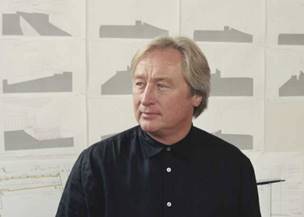
Steven Holl
Steven Holl is an American architect born in the 1947,he graduated from the University of Washington and pursued his architecture studies in Rome In 1976 he attended the graduate school at the Architectural Assosiation in London and now he teaches Architecture at the Columbia University. While teaching he works for his own study in New York. Holl won various prizes such as the Alvar Aalto medal in 1998, he was elected American best architect by Time magazine in 2001, the American Instutute of Architecht Medal of Honor and more over. Among his numerous project we can remember the Kiasma Museum in Helsinki (1998), the Simmons Hall at the MIT (2003), the Bellevue Art Museum (2001), Linked Hybrid (2009), Knut Hamsun Centre (1994-2009). He also wrote books, tje most important of is “Parallax” in which he explains his architectural view.
PROJECTS
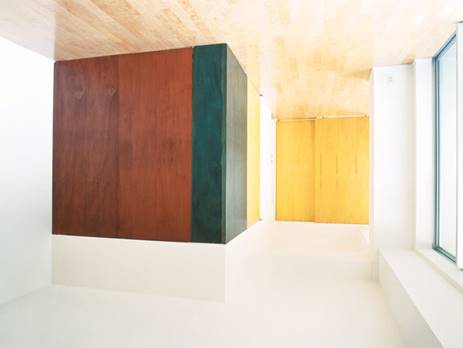
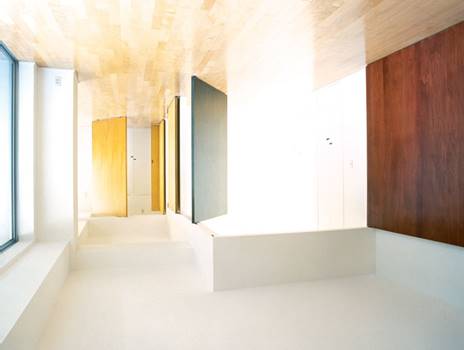
Void Space/Hinged Space Housing, Fukuoka, Japan, 1989-91
Four south-facing interlock with four active north-faced voids to bring a sense of the sacred into direct contact with everyday domestic life. The interiors of the twentyeight apartments are characterized by a hinged space, infact all the walls are built to be closed or open in order to create new interior spaces. The building has simple facedes and shops treets aligned in order to be seen as a part of the city.
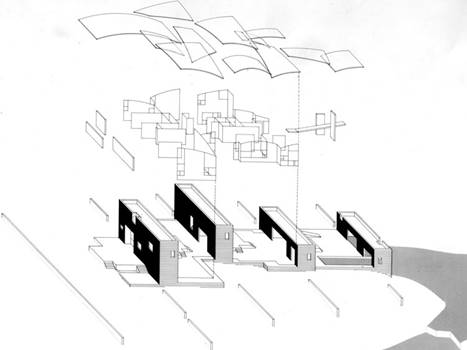
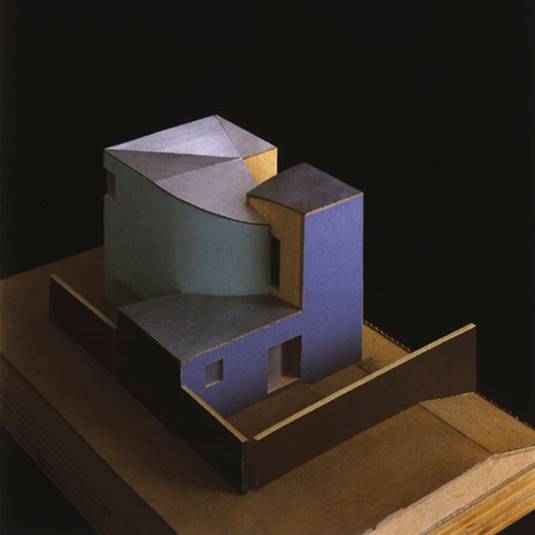
Stretto House, Dallas, Texas, 1989-91
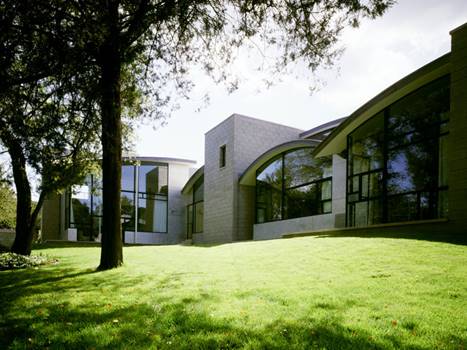
Located near three spring-fed pond with concrete dams the house is a metaphore of the site, with concrete block as spatial dams and metal framed acqueous space. The building is formed in four sections each consisting of two modes: orthogonal masonry and light and curvilinear metal. Plan is orthogonal an section is curvilinear while the guest house is an inversion.
Kiasma , Museum of Contemporary Art, Helsinki, Finland, 1998
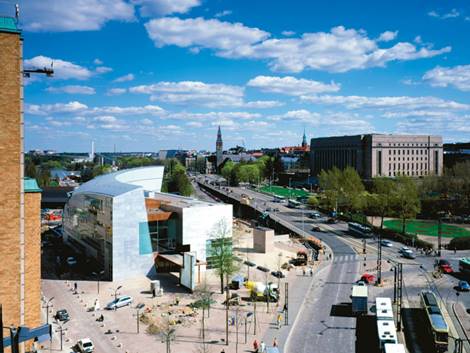
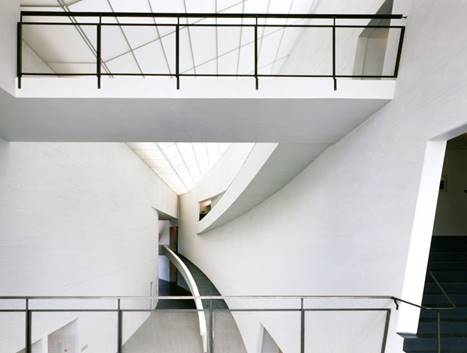
Sited in the heart of Helsinki near architectural mouments this museum is named as his shape. The “ kiasma ” shape is due to the intertwining between the building’s mass and the geometry of the city and the landscape, infact the curved part follows the shape of the pond. Thre northern horizontal light is enhanced by the waterscape, that serves as a urban mirror. the changes of the building ellevation allows parking decks and highway linkages. The museum provides a variety of spatial experiences through rooms that are meant to be silent but not static, and so differentiated by their irregularity, infact there is a differentation of the rooms due to the curve section of the building. In this way the visitor is confronted with a series of changing perspective. The dynamic internal circulation with rampes and stairs, both curving, allows the visitors to choose their own routes through the galleries. Kiasma also serves as an art forum, flexible for staged events, dance and seminars, with a cafe at the ground level and an auditorium. The interiors of the museum are a synthesis (or a kiasma ) of building and landscape.
Palazzo del Cinema, Venice , Italy , 1990
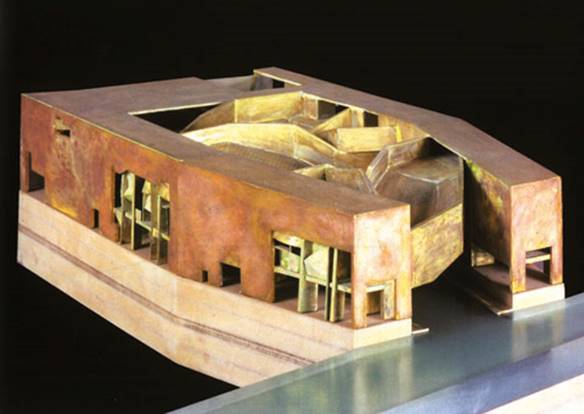
Project proposed for a competition it has a bottle shaped perimeter open to the lagoon toward Venice. Holl created with the cinemas suspended on the lagoon a sort of grotto in which a diaphanous light reflects on the water. The Project involves three type of time: collapsed and extended time expressed in the warp and extended weave of the building, and diaphanous time, which is reflected in sunlight dropping through fissures between the cinemas and the lagoon.
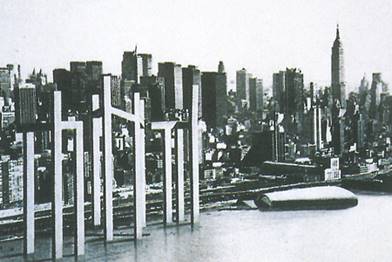
Parallax Towers, New York, New York 1990
On the 72th street on the river ultrathin skyscrapers bracket the view and create a new kind of framed urban space over water. In these hybrid buildings there are differnt functions linked by horizontal underwater transit systems.
Implosion Villa, The Hague, Netherlands, 1992
Sited on the edge of a canal this villa is a part of a group of eight different villa projected by different architects. In Implosion Villa interior spaces are pulled outward into the garden by large panes of glass and walls, and exterior space is thrust inwrd making fissures in the body of the building.
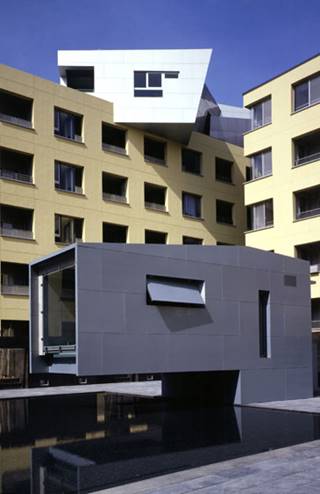
Makuhari Housing , Chiba, Japan, 1992-1996
In the new town of Makuhari the urban planners has estabilished rules for new buildings, each city block is to be designed by three or four different architect in order to achieve variety. The concept is to interrelates two different types: silent, heavyweight buildings and active, lightweight structure. The silent buildings shape the forms of urban space and passage, and has thick facades with rythmic repetition of openings, they gently bend space and passages. A celebration of miniature is taken up in the lightweiht activist force of individual characters programs.
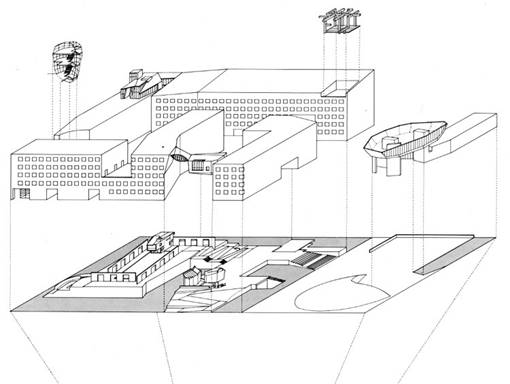
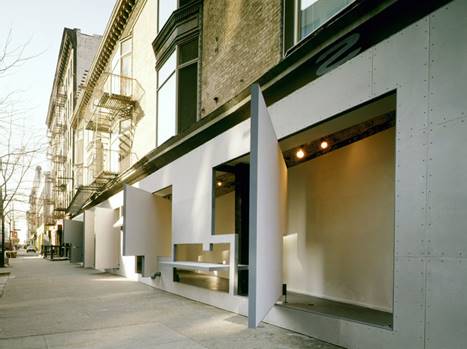
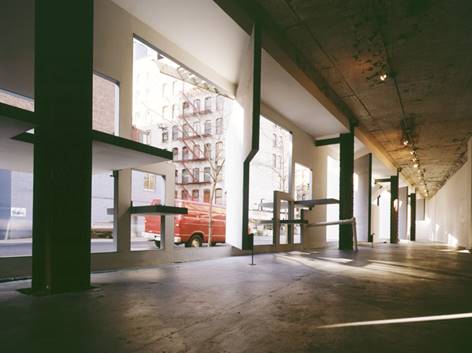
StoreFront for Art and Architecture, New York, New York, 1992-93
This exhibition space is situated in the corner of a block of intersection between Chinatown, Little Italy and SoHo and has a limited and narrow wedge space. The intervention is the result of the collaboration between Holl and Acconci who weren’t interested neither in the permanence of the facace nor the in the idea of a static gallery space. They inserted a a series of inged panels arranged in a puzzle configuration. When this panels are locjìked in their open position the facede dissolves and interior space of the gallery expands out of the onto the sidewalk.
Chapel of St. Ignatius at Seattle University, Seattle, Washington, 1994-97
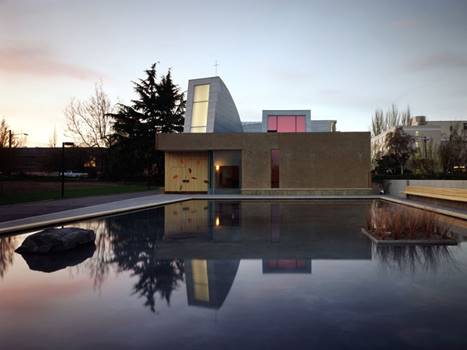
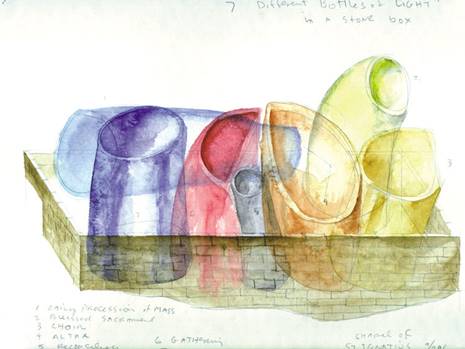
This religious building, sited in the Seattle University campus, is composed by different volumes emerging from the roof, Its concept could be seen in a sketch in which coloured bottles emerge froma stone box. Each emerging volume corresponds to a a part of the Catholic worship and correspond a different light: procession, natural sunlight; narthex, natural sunlight diffused; nave, yellow field with blue lens (east) and blue field with yellow lens (west); Chapel of the Blessed Sacrament, orange field with purple lens; choir, green field with red lens; Reconcilation Chapel, purple field with orange lens; bell tower and pond, projecting and reflecting night light.