Indice libri
Titolo originale: VERB CONNECTION : The changing status of the city, of architecture of urbanism : The generation of activity physicallying programs people, and uses
Argomento e tematiche affrontate
Faced with an increasing blurring of the frontiers between the physical and the informational dimension of our cities, Verb Connection explores the relation between virtual connections and the role of architecture in creating physical connections between people, programs and uses.
Giudizio complessivo
Giudizio Complessivo: 7 (scala 1-10)
Autori

ACTAR = “ACTivity” + “ARchitecture”*
*Coined in 1931 by the architect and landscape designer Nicolau Maria Rubió I Tudurí in his Manifesto.
ACTAR is a leading Barcelona based publisher of groundbreaking books in architecture, graphic design, and contemporary art. Its publishing program is focused on the works of established and emerging architects, designers, and photographers at the forefront of contemporary praxis and theory. Actar titles represent a broad cross section of the seminal works and individuals who affect the character of current research and practice and its relationship to the larger societal context. Actar is a publishing house for exploring open relationships between the creative mediums of the visual arts, between producers and users, between publisher and reader.
Verb connection is the third volume of Actar’s boogazine.
It was edited by Albert Ferré , Michael Kubo , Ramon Prat , Tomoko Sakamoto , Jamie Salazar, Catherine Szacka, Anna Tetas.
Contenuto
The book shows a series of projects that reveal the unpredictable effects of the evolution of our cities and highlines the role of architecture as catalyst of public life and urban activities.
-OMA_Seattle Public Library
-SIMCITY
-SHINOBU HASHIMOTO, RIENTS DIJKSTRA_Chip City
-AUDC_Ether , the One Wilshire tower, LA
-MICHAEL KUBO_ The history of RAND, Santa Monica
-STUDIO URBAN CATALYST_Palast der Republik, Berlin
-OLIVER HEISSNER_Bonn 2004
-OMA_Master Plan of Urban REdevelopment, Almere
-MICHELE PROVOOST, WOUTER VANSTIPHOUT_WIMBY! Hoogvliet-Rotterdam
-STEEN PALSBØLL, ROLAND MEIER, CLAUS PEDER PEDERSEN, SØREN HELL HANSEN, MADS BOSERUP LAURITSEN, NIELS TOFT WENDELBOE, THEIS REECKMANN_Pearl of the Harbor, Denmark
-PLOT_Maritime Youth House, Høje Torv, Harbor Baths, Copenhagen
-AMP+SUSANNE LORENZ_Badeschiff/Swimming Ship, Berlin
-SANAA_21ST Century Museum of Contemporary Art, Kanazawa
-ZAKUHIRO KOJIMA_Space Block Hanoi Model
-ARM ARCHITECTURES/SCPA POITEVIN & REYNAUD_The Giraffe, Grenoble
-ATELIER BOW-WOW_Made in Tokyo, Pet Architecture, Gae House, Das House, Furnicycle, White Limusine Yatai
Capitoli
Capitolo 1– OMA_Seattle Public Library
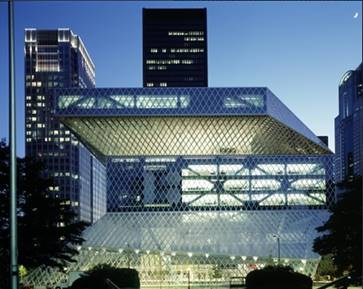
The Seattle Public Library is a powerful expression of the library’s fundamental role as the truly public building type. Since its opening it has activates and redefines its downtown context. It acts as a catalyst because, thanks to its structural and programmatic innovations, it creates a new possible public space in the city.
Technology affects the structure of the Library. There is a cohexistence between books and other media. It is a resource : it permits the totality, completeness and accessiblity of knowledge.
Flexibility- Flexibility is reached dividing the building into sections with specific uses and it exist within each section. Change is possible by change the use and programs of the sections.
Compression- Thanks to technologies we can store the books of a library in a very little space: a chip,we can store the contents of all libraries in a single library. This bring the re-thinking of the space.
Social role- The library has been trasformed from a space to read into a a social center, there are more programs even if the book is the most important one.
New equalities- Books and other media have the same importance.
Platforms- There are five platforms that host specific group of programs and medium. Since they have different purpose even size, density, opacity changes. The spaces in-between are spaces for work, interaction, play and reading. The building is conceived to be sensitive, contextual, iconic
Landscape- A continous loop of interior and exterior urban landscape makes the building.
Capitolo 2- SIMCITY
INTERACTIVE Everything in the urban enviroment is made to create a system. Every part of the system is interactive beacuse of human actions.
COUNTERINTUITIVE An urban area is a system of interacting industries, housing and people. This area develops under some conditions. After its growth, if there is not an economic mix and rennovation, the area decays. It is difficult to prevent decay because of the complex interaction between economic and social activities. There are computer models to simulate the evolution of a system. These models start from an empty area and generates the life of development leading to full land occupancy and equilibrium. A variation of the model is shown changing the guiding policies. The models show that some policies (present and past) could worsen the conditions they are intended to improve. It is clear that complex system are conterintuitive. Some actions that seems to be good in order to correct condition will often be ineffective or adverse in results, they cause more problems. As a result we treat symptoms, not causes. The effect lies between ineffective and detrimental.
CONTINGENT There is a trasformation of habit. Young people prefer to discover and learn throught a method that is similar to DIY than reading manuals. This method is successful since you interiorize a new scheme not cartographic but algorithmicbased on testing and repetition: from Civilization to Simcity.
UNAMANGED The web is really unmanaged. This is the basis of its success. It is a network with no central control. You can take part to it as you like. It takes traditional control structure and busts them up to in many small pieces that then freely join themselves.
EMERGENT In complex systems agents residing on one scale product behaviours that lies one scale above them. The movement from low-level rules to higher-òevel sophistication is what we call emergence.
SimCity is a computer simulation game of urban development. It is not as other games. You don’t win, there is not a fixed receipe for the success, it doesn’t end. Users grow their virtual cities, but the cities evolve in unpredictable ways and the control over city’s eventual shape is always indirect. This game help us to better understand the basic workings of a city from economic political or enviromentl points of view.
Capitolo 3 – SHINOBU HASHIMOTO, RIENTS DIJKSTRA_Chip City
Chip City is a project by Hashimoto and Dijkstra started in 2000 and published in HUNCH n.5. They imagine a city in wich there will be no billboards, traffic signs.. but more information , less collision, more motion. PosTec makes it possible. Everyone will have a GPS that integrates activities. PosTec will be catalyst of human activity. This will transform urban enviroment.
Capitolo 4- AUDC_Ether , the One Wilshire tower, LA
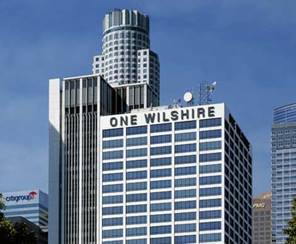
In Empire, Antonio Negri and Michael Hardt (two philosopher) describe the new world order created by the global spread of capital and communications technology. They identify a new sovereign they call Empire. In the Empire there are three tiers: Bomb (US military superiority and nuclear supremacy), Money (the economic wealth of G7), Ether (the realm of the media, culture and the global network). Even if the tiers are placeless, Negri and Hardt locate Washington DC-Bomb, New York-Money, LA-Ether. LA (with Hollywood) is the center of production of ether. The palace of the empire of Ether is One Wilshire tower. The building rapresents the trasformation of the city into a system of objects and the importance of the network in that system.
Capitolo 5– MICHAEL KUBO_ The history of RAND, Santa Monica
The RAND building is best considered not as an architecture but as a form of built research , a problem-solving exercise in the rigorous organization of a center for the production of innovative thinking. RAND represents an attempt to exploit mixed teams, and that to the extent its facility can promote this effort it should do so.
Capitolo 6 – STUDIO URBAN CATALYST_Palast der Republik, Berlin
Thanks to its open dimension the ‘Palace’ shows great potential quite unlike any other location in the Republic, it can be transformed into a provisional cultural centre community. The temporary use of this place, which is full of references to the past and symbolism, will provide new ways to explore the unknown.
Capitolo 7- OLIVER HEISSNER_Bonn 2004
Some years after the fall of the Berlin Wall and the German government moved from Bonn to Berlin, most places that where the backdrop of the historical devlopment now display emptiness and await an uncertain future.
Capitolo 8 –OMA_Master Plan of Urban REdevelopment, Almere
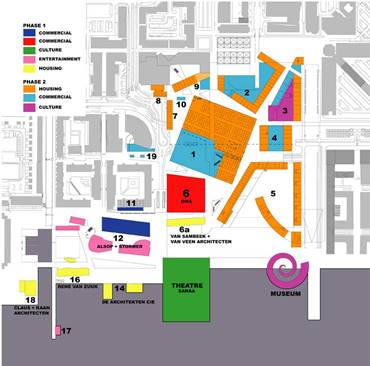
Almere is next to Amsterdam on land reaclaimed for a completely new town. It was planned in the 1970s. Its proximity to Amsterdam led to its rapid growth. Almere had become a real town, it needed a new urban centre to create identity and to be recognizable. There was a competition. OMA submitted the award-winning competition entry. They decided to add new programs in the green areas that were still open. They tried to create a point of gravity and experimented with the land and the ground level. OMA started by concentrating all the new programmes , so that they layered everything, placing each element on top of another so that it was a much denser centre.
Capitolo 9- MICHELE PROVOOST, WOUTER VANSTIPHOUT_WIMBY! Hoogvliet-Rotterdam
Hoogvliet is an old town near Rotterdam which has suffered much decay in the last thirty years. WIMBY! is a project to revitalize it.
Capitolo 10- STEEN PALSBØLL, ROLAND MEIER, CLAUS PEDER PEDERSEN, SØREN HELL HANSEN, MADS BOSERUP LAURITSEN, NIELS TOFT WENDELBOE, THEIS REECKMANN_Pearl of the Harbor, Denmark
Danish harbours have undergone an important trasformation in recent years. The functions of trade and trasportation are disappearing in these area as the haubours develop into a new urban and recreational areas. A Pearl of the Harbour is a mobile floating vessel thats city and harbour by introducing contemporary activities. The water remains an active element within the harbour.
Capitolo 11- PLOT_Maritime Youth House, Høje Torv, Harbor Baths, Copenhagen
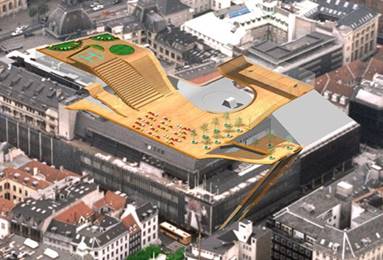
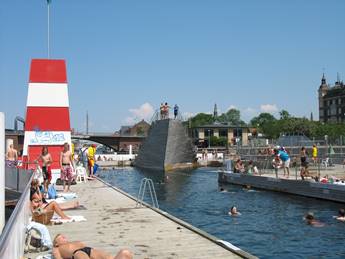
The Maritime Youth House is the result of combination of two programs. Its different programs in complementary buildings. Copenhagen suffers from facadism: it preserves the façade of building as shell, while the inner organs are constantly refurbished; Høje Torv attempts to overcome this conservation of the inner city not by changing the way it looks, but by changing the way we look at it. It constitutes a new level of urban space with views over and across the city. Copenhagen’s harbour is undergoing a transformation from an industrial and traffic junction to becoming the city’s cultural and social centre. The Harbour Bath design emerged from the desire to extend the sorrounding park into the water and the pratical requirements of accessibility, safety and programmatic demand.
Capitolo 12- AMP+SUSANNE LORENZ_Badeschiff/Swimming Ship, Berlin
The Spreebrücke project approaches the ‘bridge’ concept from a literal and figurative viewpoint. The ‘bridge’ is not only seen as a connection between two points, it also forms aconnecting line within the city. Spreebrücke is the bridge tha makes the river Spree an inhabitable place.
Capitolo 13- SANAA_21ST Century Museum of Contemporary Art, Kanazawa
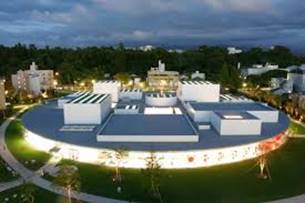
The museum is in the city center and s different important city functions. The project includes community gathering spaces, such as library,lecture hall, and children workshop, as well as museum spaces. The public and the musem zones are organized to interrelate with the public spaces around the building. Thanks to its circular shape made of glass and its organization, the museum opens to the city like a park: people can enter whenever they want, can meet and gather.
Capitolo 14- ZAKUHIRO KOJIMA_Space Block Hanoi Model
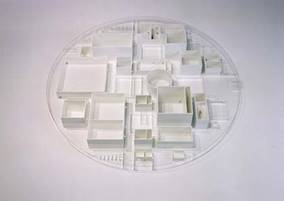
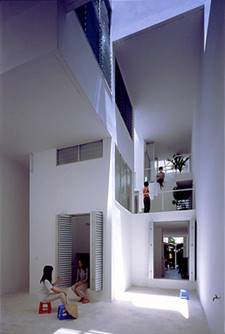
New city development can distrupt pre-existing neighborhood networks. This project attempts to redesign the naturally occurring housing typology found incrowded Asian cities. The architect wanted to create a prototype that would maintain the culture of density of these cities, but that would achieve a higher level of comfort. Individual housing units can be aggregated to create any sized apartment block and the voids encourage interaction between people.
Capitolo 15- ARM ARCHITECTURES/SCPA POITEVIN & REYNAUD_The Giraffe, Grenoble
The Giraffe is a project tought for the campus of UPMF. This building creates spaces and is a place where students enjoy themselves, relax and me t. It is not placed on the ground but on legs so that it relates with the context and a raised courtyard is created. Theproject is organized over three levels and arranged along passageways. These are places for conviviality. The façade is covered by a skin that nuances the light and during night comes to life when people circulating around the space abve become Chinese shadows. The Giraffe’s façade becomes the symbolic iconographic screen that characterises the UPMF as a whole, an attempt to do away withs between inside/outside.
Capitolo 16- ATELIER BOW-WOW_Made in Tokyo, Pet Architecture, Gae House, Das House, Furnicycle, White Limusine Yatai
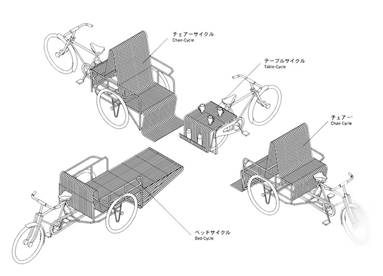
Architecture doesn’t always assume the shape of a building . The Made in Tokyo and Pet Architecture projects demonstrate an unconventional reading of the city. Thanks to this analysis, Tokyo becomes a uber-functional living crature. It also could be an efficient urban project. Parallel to these projects, Atelier Bow-Wow designes houses (as Gae House and Das House) that acts as urban catalysts. They are really small but represents the city fabric of Tokyo. These houses have become “tools” to costumize the city. Furnicycle and White Limusine Yatai are form of moving architecture. They are equipments for the city to connect people.