Indice libri
Argomento e tematiche affrontate
The book invites the reader to enter the dialogues between the author and the architects he works with, sharing the intimacies of the design process through sketches and first principles.
Projects range from a Villa in Bordeaux to a large Transport Interchange in Arnhem, from a large canopy in Lisbon to the V&A Spiral in London and an Exhibition Centre in Lille, highlighting the
collaborations Cecil Balmond has had with the architects Ben van Berkel, Daniel Libeskind, Rem Koolhaas, Alvaro Siza and Peter Kulka with Ulrich Königs.
Giudizio complessivo
Giudizio Complessivo: 7 (scala 1-10)
Autore

Cecil Balmond
Cecil Balmond is an engineer, designer, master builder, mathematician, thinker and writer. His theory of the informal is grounded in his collaboration over the last 25 years with many notable architects including Rem Koolhaas, Daniel Libeskind and Alvaro Siza. Charles Jencks remarked, when asked to list the fifteen most important buildings and projects that were changing
architecture, that “to my amazement, Balmond scores higher than any architect, if the engineer is credited with partial creation”. Balmond’s recent projects include the Serpentine Gallery Pavilion with Toyo Ito, and the largest fabric sculpture in the world with Anish Kapoor, recently opened in
the Turbine Hall at Tate Modern. Balmond was born in Sri Lanka, where he studied at university, before leaving for further education in England. His interest lies in the genesis of form and the overlap of science with art,
using music, numbers and mathematics as vital sources. He is Saarinen Professor at Yale, was Kenzo Tange Visiting Critic at Harvard, is a member of the Arup Group Board, and Chairman of Arup’s Europe Division. He was recently appointed a Fellow of the RIBA and was awarded the honorary Diploma of the AA. He lives in London.
Contenuto
The book presents Balmond’s unorthodox ideas through a series of
interlinking stories, in which anecdote vies with analysis,
science with art. This approach enables each story (or chapter)
to focus on a particular aspect of Balmond’s problem-solving
methodology without replicating the already well-documented
perspective of the architects on each of these iconic
projects.
Stories relating to each project are dispersed throughout the
book, each free to graphically explore its own theme.
Counterpoint comes from placing different projects alongside
each other. Pace, tone and emphasis vary to suit content. Design
is inspired more by mathematics books and children’s fiction
than by books on architecture or engineering. Each project has a
‘signature’ colour, thereby visually reuniting the different
stories. The contents page and cover use these colours to map
the rest of the book.
Capitoli
Capitolo 0– PREFACE
The preface is made by Charles Jencks and Rem Koolhaas. They both give their own opinion about the book, and probably the implication was that if I didn’t agree with them I was somehow unable to understand.
Rem Koolhaas writes “Cecil Balmond has, almost single-handedly, shifted the ground in engineering – a domain where the earth moves very rarely – and therefore enabled architecture to be imagined differently.”
Capitolo I – INTRODUCTION
The author exposes his ideas and consequent questions about architecture. He starts from the beginnig, from the Greek word “techne”, then he touches the numers, the early Greek mathematic rules and their notion of symmetria. Balmond writes “Then I began to question what these regular framings of closed squares and rectangules were; were they containers of an empty inanimate space?”. He will answer us undirectly in the book later, as he will do with the other questions he writes about the loose geometry giving shape and formdynamics and static, the non-linearity.
Capitolo II- BORDEAUX VILLA
Villa Floriac, Bordeaux: diary of making a box ‘fly’
This chapter seems a diary, the diary of an engeneer, and architect, a designer.. It shows us day by day (8 days) the problems and the solutions encontred during the project and the building of this villa, even with the author’s comments and thinkings. From the beginning of the fist sensation, with all the classic examples; to the structural problems and even the spending reviwes they had to aplly to solve the impellent costs of a bigger beam instead the of the concrete floor.
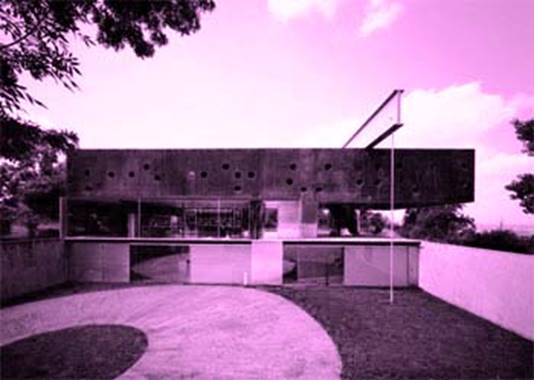
“The idea of a table is destroyed. Instead, the dynamic is launch.”
Capitolo III – KUNSTHAL
Kunsthal, Rotterdam: breaking the Cartesian cage
In this chapter it’s treated the most informal architecture: Koolhas’ Kunsthal.
Balmond explain us how the projectist intent was to destroy and escape the cartesian rules.
He treats also the four proposals to be made in Kunsthal: brace, slip, frame, juxtaposition.
For each one of these four porposals he gives us practical examples, helped by drawed schemes and nice pictures, of them.
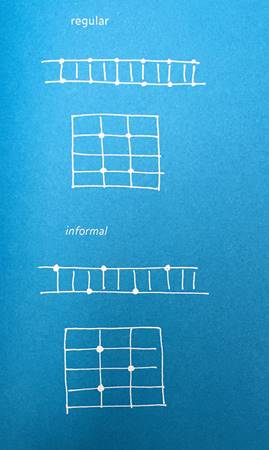
“Let the informal in. Have a syncopation instead of the dull metronomic one-two repeat of post and beam.”
Capitolo IV- INFORMAL
Balmond gives us many examples and a detailed glossary of the key-words that compose the meaning of informal.
Sketches and practical elements are very usefull to understand the definition of this word.
This chapter treats constructive techinques, philosofic concepts and sociology elements as one only network that works together.
Capitolo V– THE CHEMNIZ SOLUTION
Sports Stadium, Chemnitz: algorithm versus mimesis
The author opens up this chapter with a question to all of us: shoud a stadium in a cross-section be a composite building of dependant attachments; why not try different layers that are indipendant?
After that he talks of the process that borught the architects Peter Kulka and Ulrich Konigs to the concept, to the paper model. Sketches, sensations, motivations and feelings are envolvers of the reader into the projecting process.
The questions that the architecs asked themselves and the solutions they thought are well explained.
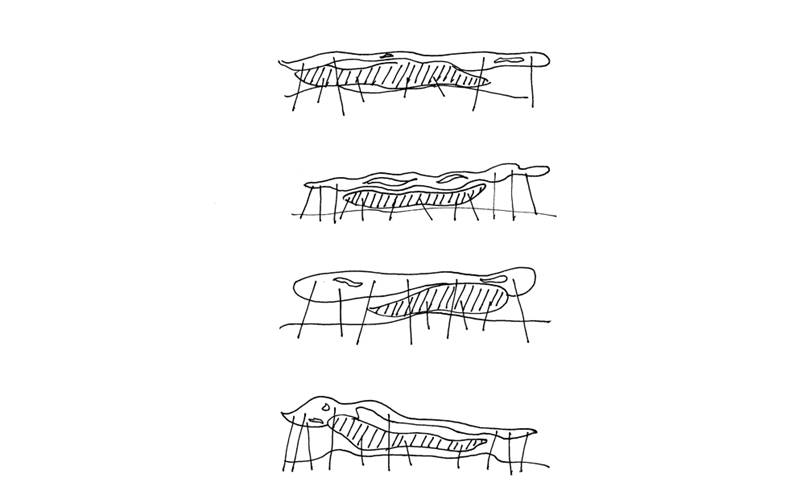
“We wanted something different, eccentric orbits, a release of the wild energies that Nature seems so easily to control.”
Capitolo VI – REVISITING LILLE
The best way to resume this chapter is copy Balmond’s introduction:
“The fantasy always compeals, the thought of new plan is exciting.
In contrast, hard reality, the end result oh what we do in the name of that quest, is less interesting. Once we’re done with design the next adventure begins opening up new horizons. The concentration is on start-up rather than finish.
But when the ambition is huge and way beyond the normal scope of a project, then the sheer scale and presumption needs its own incredulity questioned. Did it work? Was the ambition right? When that plan is to supersede the old with the new and redefine a whole city centre than the project and its theory are worthy of interrogation, repeatedly.
It was with this in mind that I revisited Lille, to return as a visitor and walk the streets, to view the contruction and to partake of the vision it offered. In the process I hoped to learn something new about the project again.”
From this introduction, we can easily understand the content of the chapter: a sommary of remembered feelings and sensetions walking in Lille after the project.
Capitolo VII- SPIRAL
V&A Spiral, London: animated geometries
Informal takes an other meaning (different from the Kunsthal), it’s decomposition of the normal surfaces and elements that compose a building. Balmond shows us the thinkings and the experiments beyond the shapes and the geometries of the Spiral.
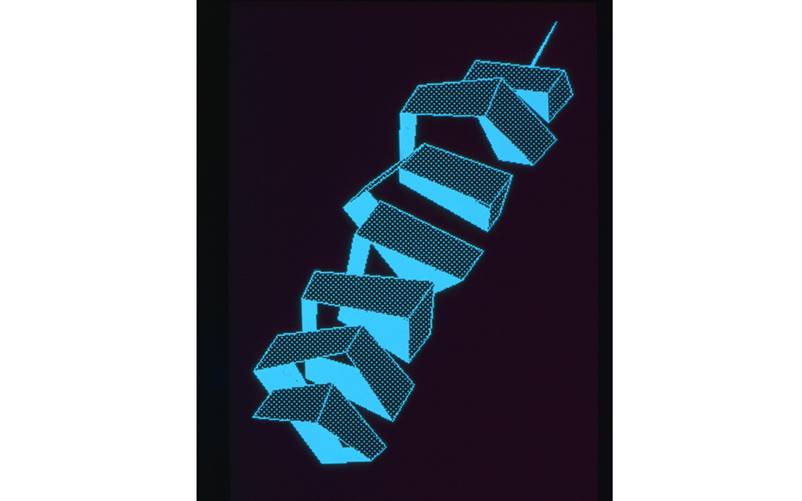
“Does space have to be container-like and neutered to house
works of art?”
Capitolo IX –MANIFESTO
It’s a collection of Balmond’s high sentences about architectural composition and philosophy in architecture.
Capitolo X- WINDOWS OVER BORDEAUX
Black and withe pictures of the main beam’s holes that frames the view from the inside of Koolhas project in Bordeaux
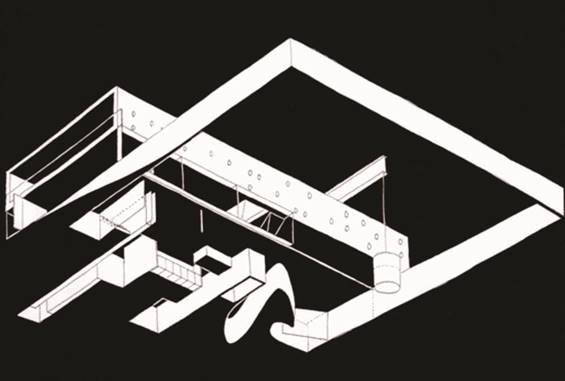
Capitolo XI- FRACTILES
It’s all about Cecil Balmond and Daniel Liebeskind reasoning on tiles. They consider all the examples in hisotry, during the Victorian Age, in the Ammann,.. also the mathematic rules and proportions that alouds to create so armoniously patterns like Fibonacci’s numbers and the golden section.
Capitolo XII- FRACTAL
This chapter talk of the fractal and the crations possibles with them, like starting from a triangle we can drow in it many other smaller triangles all similar, or we can draw from a square a chess desk.
Capitolo XIII- CONGREXPO
Congrexpo, Lille: city within city
Balmond explains all the difficuties born from the insufficent money to realise the buiding over the railway. All the problems coming from the shed of the Congrexpo, of the structre, how to solve the tensions and not to give to the visitors the impression of being soffocated by it or to lose themselves under that big shadow.
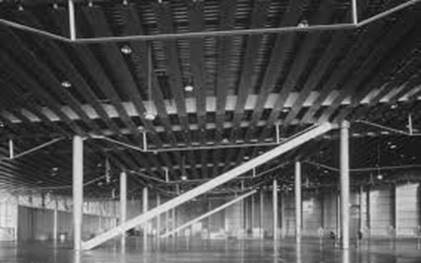
“It was essentially a one storey, shed-like building. But what a shed it turned out to be.”
Capitolo XIV- CANOPY
Portuguese National Pavilion, Lisbon: structure as a cut in space
Probably the most fascinating chapter of the book, reveals all the problems and complications of this project. From the easiest idea of a line, to the difficulties of the building process, the intuitions to solve the tensions and cracking problems of the concrete; the choice og using such an heavy material like the concrete to transmit the idea of lightness and floating canopy.
It is lovely written and treats complicated calculations with bright simplicity, associated with clear diagrams and draws.
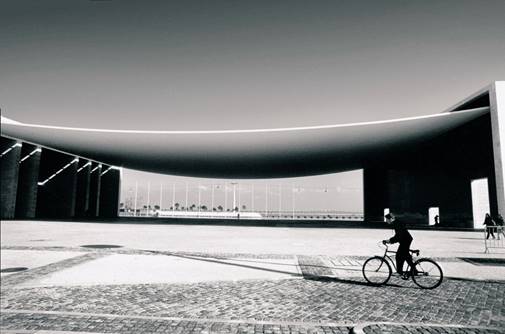
“The mystery is in the unseen calculation of exact balance, of up versus down.”
Capitolo XV - ARNEM
Central Station, Arnhem: flow diagram as enzyme
The theme treated in the chapter can be resumed in using modern modeling technologies to create shapes and structures different from the one we are used to know. The creation of a natural shape, as an organic element, where walls roofs and floors converge one into the others. This is the Arnem’s Station’s project.
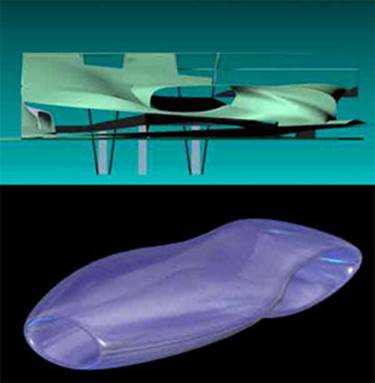
“Layering and folding take over and the concerns of a Newtonian mechanics fall away.”