Indice libri
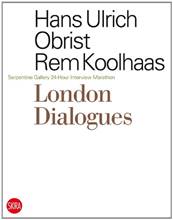
Titolo originale : London Dialogues – Serpentine Gallery 24-Hour Interview Marathon
Contenuto
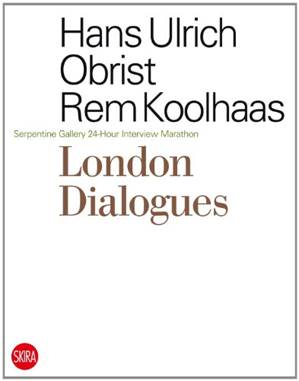
The authors interviewed 56 people coming from a wide range of topics and subjects. They focused on the city of London interviewing people who knewed had something in common with the city. The main purpose is to identify bridges between art-design-architecture because there is no need to actually be busy defining the borders between things.
Giudizio complessivo
Giudizio Complessivo: 7 (scala 1-10)
Autori
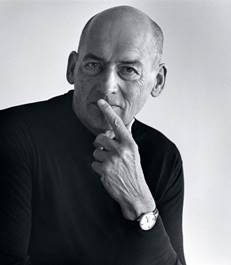
Koolhaas
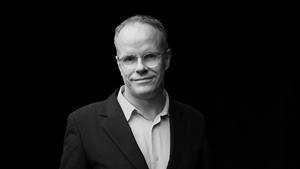
Ulrich Obrist
Authors : Ulrich Obrist & Koolhaas
Remment Lucas "Rem" Koolhaas ( born 17 November 1944) is a Dutch architect, architectural theorist, urbanist and Professor in Practice of Architecture and Urban Design at the Graduate School of Design at Harvard University. Koolhaas studied at the Architectural Association School of Architecture in London and at Cornell University in Ithaca, New York. Koolhaas is the founding partner of OMA. In 2000, Rem Koolhaas won the Pritzker Prize.
Hans-Ulrich Obrist (born 1968) is an art curator, critic and historian of art. He is Co-director of Exhibitions and Programmes and Director of International Projects at the Serpentine Gallery, London. Obrist is the author of The Interview Project , an extensive ongoing project of interviews. He is also co-editor of the Cahiers d'art revue.
List of interviews
Abake
Kenneth Adam
David Adjaye
Tariq Ali
Ron Arad
Shumon Basar
Anat Ben-David
Adam Caruso
Hussein Chalayan
Michael Clarck
Peter Cook
Mark Cousins
Marcus du Sautoy
Paul Elliman
Tony Elliott
Brian Eno
Pedro Ferreira
Sophie Fiennes
Ryan Gander
Ant Genn
Gilbert & George
Jonathan Glancey
Zaha Hadid
Richard Hamilton
Ussell Haswell
Susan Hiller
Roger Hiorns
Damien Hirst
Chales Jencks
Isaac Julien
Patrick Keiller
Jude Kelly
Hanif Kureishi
Scott Lash
Doris Lessing
Ken Loach
Hautam Malkani
Doreen Massey
Tom McCarthy
Gustav Metzger
Mary Midgley
Markus Miessen
Chantal Mouffe
Tim Newburn
Tim O’Toole
Julia Peyton-Jones
Olivia Plender
Milan Rai
Peter Saville
Yinka Shonibare MBE
Iain Sinclair
Squarepusher aka Tom Jenkins
Marina Warner
Eyal Weizman
Richard Wentworth
Jane and Louise Wilson
Cerith Wyn Evans
Common questions
- what are your toolboxes?
- Who have somehow been a toolbox for you?
- Any unrealised projects?
- Do You have any dream for the city of London?
- Can you somehow map the city of London?
- Is there such a thing as a theory of the city?
- When did you first become related to the city of London?
- Can you explain your current moment in relation to your whole practice?
- Is there anything you wanted to build in London?
Scheme of a standard interview
- discussion about the last project of the interviewed
- explanation of the first relationships with the city
- projects realised in the city / for the city
- understanding a possible map of the city
- personal idea of the city
- discussion about some more projects of the interviewed
- thoughts and ideas for London in future
- unrealised projects or dreams
Zaha Hadid interview – main topics
Can you tell us what’s your contemporary idea of London?
I still feel it is a very exciting city because it is so impredictable. Maybe it is more predictable than before but every time you think you know it well, something comes along and surprises you. And I think that also shifts your opinion abaout what you might do there, constantly. So in that sense, it’s still a kind of educational situation for me.
I think your career is at a very interesting moment where you have to decide whether to repeat things or whether to continue to innovate.
I am in a position now where I can do both, there are things you can use as a generic project, but there’s still an excitement about inventing things. I can give you the example of the MAXXI in Rome, ten year of endless work not winning a single competition gave us an incredible opportunity providing us with an enormous repertoire that allowed us to invent. It allowed us to rely on our own experience and previous inventions to move on to the next project. I don’t think you have to reinvent the wheel all the time.
What is your feeling about entering, as an Arab, the Arab world at his moment of maximum Westernisation?
I think that that part of the world is now living in a combination of extreme Westernisation and a pride Arab identity, I think that the effect od Arabness coincides with certain interests right now in terms of the whole landscape project, which is related with dunes and stuff like that. There is aldo interest in pixelation and geometry which relates a great deal to the Arab identity in terms of algebra, geometry and mathematics. It is suddenly possible to connect in terms of materials and ideas.
Can you tell us about your last project in Beirut?
In Beirut we had to plan a bank headquarter and a building for the AUB (American University of Beirut),
against my original idea they adapted the idea of a perimeter block, which is not really apporpriate for the city since it is not Berlin. Instead of making a thousand blocks the made five, so the scale is weird, by doing that they made Beirut a tabula rasa – into one flat plane – even though the city was much more layered. And they did not have common discourses about complexity and different ways of dealing with urban renewal.
Can you explain us your studio’s transition from being almost a miniaturist to a kind of hypermodern and contemporary organisation and how you manage big works with few people?
I resisted digitisation for a very long time, as you well know the most important trick is to delegate.
You know from early on you can’t do everything yourself, you can do bits of it yourself, you can make people do things the way you want them done, but you have to rely also on their own invention and their own challeng and abilities. I think that teamwork has been very important to me for a long time. I have always believed in it and that is why it is manageable.
There are equally, two periods of your life, one when you are honoured and a previous one whne you were neglected, can you tell something about this process?
When I was neglected or ignored I always thought thai it would be a passing phase. I am fundamentally an optimist, I don’t neither take the acclaim too seriously now, it doesn’t really affects my life.
Can you explain us how you asses the current moment right now in the world and how you see it?
For me it’s a very interesting moment. However, it’s still very difficult for women to operate as professionals. There are still worlds you have no access to, in practice, I still offer resistance all the time, and I think that keeps you on the go. It’s not that I am there and everybody says yes to me, it’s still a struggle, despite having gone through it a hundred times. It’s not necessarily always great but I think it keeps you in place, and it also makes you think about things in a different way.
Do you think there is such a theory about London?
The old theory about London is always about a city which is made of many villages that merged and created areas of dendity and a metropolitan condition. I think all the new development is very hard-handed and not as light as it could be. It is still a fortified city: I feel that the main focus is still on the urban perimeter block, and this is also something that could be cahnged.
I was wondering if you have any dream projects for London or any unrealised projects you would like to see happen.
London always inspires projects that are unpredictable, look at the Olympics site. I still think this projects are possible, there is an obsession here about making everything look nice orfeel nice, but niceness is not appropiate in London because the city relies on a slight messiness. If it were possible to do a project which is non so even clear, it would be mor einteresting than this idea
Book’s Pros and Cons
All the interviews relate to very time-specific topics, there are not many topics that could be taken as general or as a theory for the interviewed. All the interviews take as given the person’s story/art/style/work. The people come from a very wide range of arts and culture, the book gives a very colorfull portrait of London culture.